OSTrails Makes Waves at International Data Week 2025 and RDA in Australia: Calling for a Future Beyond Bureaucratic DMPs

OSTrails was present at the International Data Week 2025 (IDW2025), showcasing its position as a leading innovator of practical, automated Open Science solutions. With two well-received posters and a contribution to the conference’s Data Management Plan (DMP) session, the project highlighted how its integrated approach is transforming data management from an administrative obligation into a seamless part of the research process.

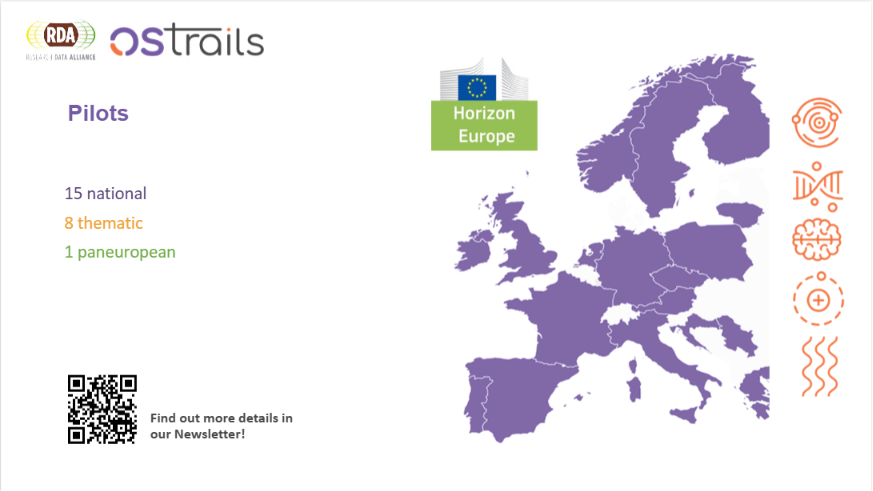
With 41 partners and 25 pilots spanning national, thematic, and European infrastructures, OSTrails is coordinating one of the largest efforts in research data management interoperability.

OSTrails in RDA/IDW at glance

  • ~40 attendees from research institutions worldwide
  • 2 posters showcasing researcher-centered and technical perspectives
  • Global DMP platforms collaborating through OSTrails' API framework
  • 1 consensus: researchers want automation, not administration

In conversation with attendees

The two OSTrails posters drew steady attention throughout the conference, each highlighting a different dimension of the project's approach.

Anca Hienola’s poster, “From Bureaucracy to Usability: How OSTrails Simplifies Open Science,” focused on the researcher journey showcasing how OSTrails connects machine-actionable DMPs (maDMPs), FAIRness assessment, and Scientific Knowledge Graphs to create a seamless, automated research workflow. The visual demonstration of how automation reduces administrative burden while improving research quality sparked genuine discussions about adoption in institutional settings.

Picture2

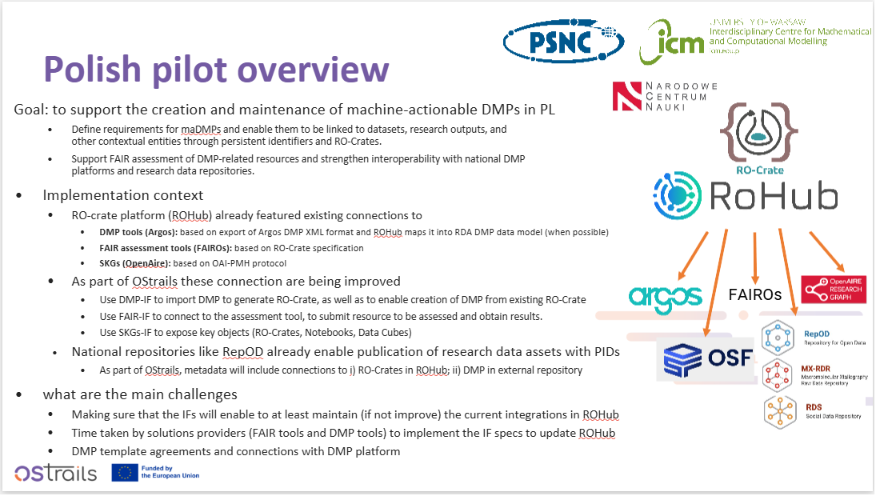
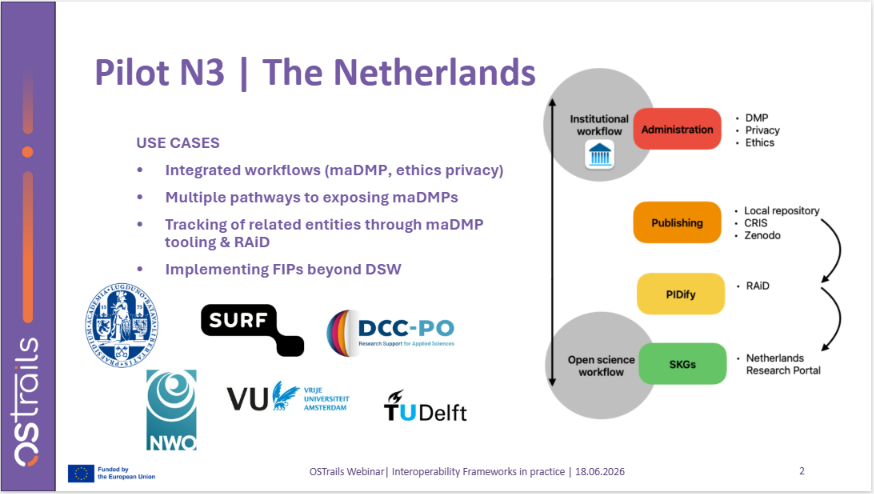
Andres Tabima's poster took a complementary technical perspective, presenting OSTrails' federated architecture and the challenges of achieving interoperability at scale. With 41 partners and 25 pilots spanning disciplines and infrastructures, the poster demonstrated how the Interoperability Reference Architecture and Plan-Track-Assess framework enable coordination across diverse RDM tools while preserving domain-specific autonomy. The presentation of the emerging OSTrails Commons, which serves as a shared environment for services, methods, and training, resonated particularly with infrastructure providers interest and ambition regarding long-term sustainability and federation with the European Open Science Cloud (EOSC).

Together, the posters illustrated OSTrails' dual focus: making research workflows easier for individual scientists while building the technical infrastructure to support interoperable, FAIR-aligned science at scale. The visualisation of the link between researcher workflows, automation, and FAIR outputs helped bridge the gap between policy and practice across both presentations.

The visual link between researcher workflows, automation, and FAIR outputs helped bridge the gap between policy and practice, leading to discussions on how to implement these mechanisms within institutional systems.

Picture3

Challenging the Status Quo on maDMPs

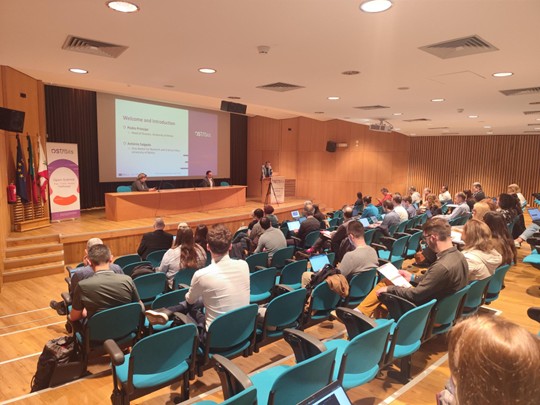
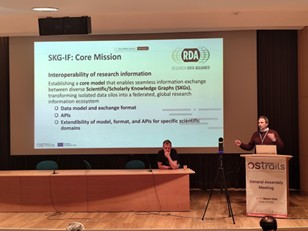
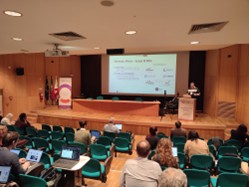
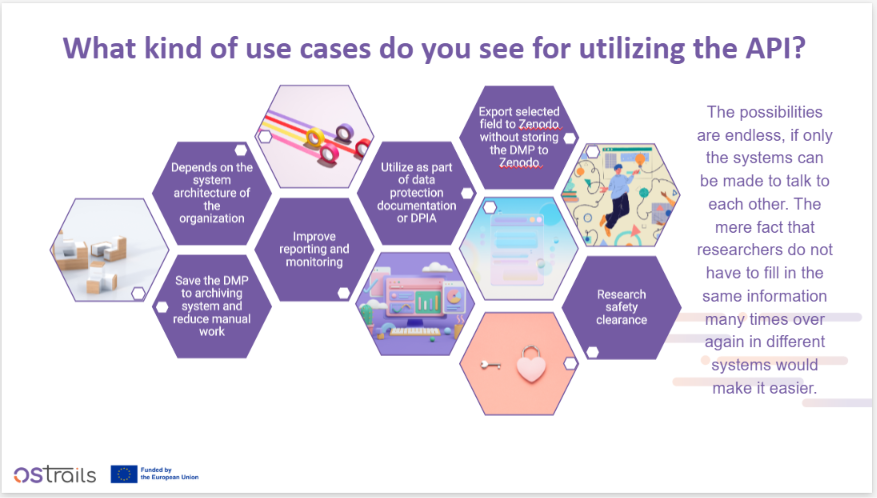
Approximately 40 researchers, data stewards, and infrastructure providers gathered at the maDMPs  session to learn and advance how computers can read, update, and integrate maDMPs into research workflows automatically.

Anca Hienolaopenly stated that “DMPs in their current form are useless and bureaucratic.

Picture4

During the session, Marek Suchanek and Andres Tabima from OSTrails co-chairs of the maDMP groups, presented the project’s vision for machine-actionable DMPs that evolve dynamically as research progresses. The session also featured progress updates from other DMP platforms of the project (About - OSTrails) as well as DMPTool (US), and DMP Assistant (Canada), demonstrating the global momentum behind API implementation.

The exchange underscored a growing consensus: researchers want automation, not administration. OSTrails’ approach, embedding DMPs directly into scientific workflows and linking them to data repositories and FAIRness tools, was recognised as a concrete step towards that goal. The session also prompted important discussions about DMP quality, reusability, and how to balance technical infrastructure improvements with making DMPs genuinely valuable to researchers.

OSTrails Moving Forward – What's Next

OSTrails will deploy its DMP evaluation service in 2026, enabling semi-automated assessment of DMP quality and interoperability. The maDMP API Working Group will continue developing technical specifications, with multiple platforms piloting implementations throughout 2025. This work informs and supports the maintenance of our  established RDA output, the DMP Common Standard.

The enthusiasm at RDA/IDW2025 suggests the research community is ready to make the shift from static compliance documents to dynamic, researcher-centred tools that support scientific work. We are looking forward to sharing what this looks like in the next RDA Plenary!

Picture5


  • Created on .
  • Last updated on .
  • Hits: 22

Thematic Pilot Interview: Physics

Read the Interview with the Thematic Pilot for Physics to discover the latest updates on OSTrails pilot studies. Explore pilots progress in integrating open science principles and advancing research assessment. This month we had the pleasure of speaking with Renaud Duyme (European Synchrotron Radiation Facility, France) and Majid Ounsy (SOLEIL Synchrotron, France). 

     
  - Renaud Duyme   - Majid Ounsy


"Within the OSTrails project, our main goal objective is to enhance access and discovery of datasets generated by scientists in Photon and Neutron facilities. We aim to increase the visibility and reuse of these datasets across multiple scientific domains by integrating our data repositories with external tools and services, such as Data Management Plans and Scientific Knowledge Graphs."


-Can you briefly introduce your organisations? How does they contribute to EOSC?  

The Photon and Neutron Open Science Cluster (PaNOSC) provides the international scientific community with unique experiment tools to observe materials and living matter. PaNOSC is a European science cluster grouping multiple research facilities. PaNOSC is a candidate node in the EOSC federation.

For OSTrails, 2 institutions represent PaNOSC: the ESRF (Grenoble, France) and SOLEIL (Paris, France). Both are photon facilities hosting synchrotrons, often described as giant microscopes. A synchrotron "films" the position and motion of atoms in condensed and living matter and reveals the structure of matter in all its beauty and complexity. It provides unrivalled opportunities for scientists in the exploration of materials and living matter in a very wide variety of fields: chemistry, material physics, archaeology and cultural heritage, structural biology and medical applications, environmental sciences, information science and nanotechnologies.

The ESRF is the world's brightest synchrotron and is part of the European Strategy Forum on Research Infrastructures (ESFRI landmark). SOLEIL is a French national Research Infrastructure. The users of the ESRF and SOLEIL synchrotrons come from universities and laboratories from all over the world.


-What are you most excited about in OSTrails? What are you looking forward to?   

The OSTrails project is a great opportunity for us to continue integrating open science and FAIR concepts in Photon and Neutrons facilities.

-How is planning, tracking and assessing research being realised in your scientific domain?

Here is a typical workflow in a PaNOSC facility: a scientist sends us a proposal to perform an experiment in our facility. After selection, we grant access to our instruments and schedule an experiment session. During a session, datasets are generated and referenced in our data catalogs. Our librarians then track scientific articles mentioning these experiments and datasets. Datasets have an embargo period (3 years for ESRF) before being open access.

Datasets are key assets of scientific publications. We need to ensure that the datasets produced in our facilities can be properly discovered, used, cited, and finally even reused by other scientists.

Our community is developing the Photon and Neutron Experiment Technique (PaNET) vocabulary. This vocabulary defines a list of specific experimental observation techniques used in our facilities (for example: “x-ray diffraction”, “small angle scattering” ...). It gives us a generic way to annotate datasets in our repositories (ex: ESRF's Data Catalogue). ESRF is also minting dataset DOIs (Digital Object Identifiers) with DataCite. We also annotate DataCite metadata.

PUMA (Publication and User experiment metadata Analyser) is an internal application available in a few PaNOSC facilities. PUMA provides standard instrument dashboards and search features. It is fed by the facility library catalog and the user office proposal/grant system. Multiple facets are involved: publications, proposals/grants, instruments, scholarly journals, scientists, institutions (laboratories, universities), datasets. These facets, when linked as entities, provide a Scientific Knowledge Graph (SKG). This SKG allows us to better track and understand science produced by our facility.


-Can you provide some details on your pilot's main actors, services and priorities? How will your pilot adopt the results of OSTrails?

Our OSTrails pilot will involve the following services: ESRF’s Data Catalog, PUMA and DSWizard DMP Tool.

We would like to report on the quality of our datasets. This assessment can be done in various workflows including the Data Managment Plan (DMP) evaluation process, when a DMP is mentioning one of our datasets.

We also want to showcase how we can enhance and standardise the exchanges of metadata related to our datasets between these services. Typical elements we would like to exchange are publication/dataset citation links and publication/grant citation links. The SKG-IF will be used for these data exchanges.


-Ongoing activities and Next Steps?

ESRF is updating internal instrument data workflow to plug and output PaNET techniques in the metadata of our data portal datasets and DataCite DOIs. Work has been done to push missing information to DataCite DOIs (license, affiliations, grant...). ESRF is involved in the delivery of the SKG-IF API.

SOLEIL is currently adapting its internal webservices (user office and library systems) to set up the PUMA application. SOLEIL is evaluating the DMP platform: DSWizard.

For the next steps, ESRF would like to use the OSTrails FAIR assessment IF. We will focus on the metadata quality of our datasets. This work will be done with the ESRF Data Catalog team, the FAIRsharing team and the DSWizard team for the ESRF local DSWizard instance.

Thematic Pilots, Pilot Interview

  • Created on .
  • Last updated on .
  • Hits: 283

National Pilot Interview Portugal

Explore the National Pilot Interview from Portugal to discover the latest updates on the OSTrails pilot studies. Dive into their national activities and learn about their progress promoting the use of machine-actionable DMPs, enhancing the FAIRness of digital objects stored in their repositories, and strengthening interoperability among RDM services. This month, we had the pleasure of speaking with Pedro Príncipe, Filipa Pereira and André Vieira from the University of Minho and Foundation for Science and Technology (FCT).

 Picture 1 portugal_n3.jpegAndre.jpeg

"Through the OSTrails pilot, we expect to strengthen our institutional and national research ecosystems by advancing the implementation of machine-actionable DMPs, improving FAIRness of digital objects deposited in our data repositories, and fostering interoperability across RDM services. These developments will help us deliver more efficient, integrated, and trustworthy infrastructures, while embedding Open Science and FAIR principles into research practices."

 
- Can you briefly introduce your organisation(s)? How does it/do they contribute to EOSC?

The University of Minho (UMinho), funded in 1973, has as its mission is to generate, disseminate and apply knowledge, based on freedom of thought and the plurality of critical exercises, promoting higher education and contributing to the construction of a model of society based on humanist principles, with knowledge, creativity and innovation as factors of growth, sustainable development, well-being and solidarity.

UMinho, via the Documentation and Libraries service, is and was actively involved in EU projects such as EOSC-Beyond and EOSC-Future, and is member of the OpenAIRE AMKE, contributing to the development of key EOSC core components.

The Foundation for Science and Technology (FCT) is the national public agency supporting research in science, technology and innovation, covering all areas of knowledge. It is a special regime of public Institute under the supervision and oversight of the Ministry of Education, Science and Innovation. As the national funding entity, FCT is committed to adopting instruments and services that promote the practice of Open Science within the framework of the scientific activity it funds. 

FCT is a mandated organisation of the EOSC Association with national representatives on EOSC’s Steering Board, and active participation in EU Open Science projects, including EOSC-Synergy.

Through FCCN, the digital services of FCT, a National Programme on Open Science and Open Research Data is being implemented, which is expected to greatly support the national scientific community on FAIR data management and practices

What are you most excited about in OSTrails? What are you looking forward to?

UMinho is participating in the OSTrails project with the aim of contributing and benefiting from its outcomes, particularly those related to the implementation of use cases outlined in the technical work packages. Having already developed services to support Research Data Management (RDM) activities for its researchers, UMinho expects OSTrails outcomes to enhance the quality of these services and enable new capabilities through improved interoperability between RDM components. Additionally, UMinho is committed to contributing its expertise and experience to the project and its pilot partners.

The FCT team is very motivated to take part in this project. We are looking forward to contributing to the tracking and assessment of the level of FAIRness of the Digital Objects (DOs), sharing experiences and learning from other partners, ensuring engagement and awareness within the scientific community.

How is planning, tracking and assessing research being realised in your country/scientific domain?

UMinho, a pioneer in open access to knowledge and Open Science, with OA repository since 2003 and an OA mandate since 2005 , established recently a new Open Science Policy (June 2025), with relevant guidelines and requirements aligned with the leading entities in the field. These guidelines value openness, transparency, reproducibility, credibility, efficiency, and quality in research, with a view to strengthening the scientific system and increasing its recognition by citizens. The policy includes, among others, the following: Alignment with the requirements of major national and international funders, reinforcing the mandatory deposit of publications in the institutional repository (RepositóriUM) and the use of open licences; Clearer guidelines for the management, deposit and opening of research data, aligned with the FAIR data principles; Requirement for researchers to deposit the data necessary to validate the results presented in scientific publications in a trustworthy repository, preferably in UMinho's institutional repository (DataRepositóriUM) or in an appropriate disciplinary repository.

In addition, UMinho offers a Data Management Plan (DMP) service, a local instance of OpenCDMP / Argos, in which researchers can create their DMPs using templates from EU, national funder FCT and a template tailored to PhD students. A CRIS research portal is also under development, which will greatly support the institution's research results monitoring activities.

FCT is actively involved in promoting Open Science. A formal RDM policy aligned with the FAIR data principles and important initiatives is expected to come into force soon. FCT is enhancing infrastructures and services to ensure compliance with the policy and with RDM best practices.

FCT launched in 2022 a service dedicated to RDM: the POLEN service. This service provides a Data Management Plan System, based on ARGOS, including FCT’s template aligned with Science Europe’s guidelines. To cover as much of the research data life cycle as possible, other important services will be made available to the community. These include the POLEN Research Data Repository and a Sync & Share Service for active research data.

Can you provide some details on your pilot's main actors, services and priorities? How will your pilot adopt the results of OSTrails?

The pilot’s main actors will be the scientific community, comprising researchers and service end-users. 

Concerning services and priorities:

The UMinho provides two main services to support the RDM activities, namely a DMP service and a Data Repository. The DMP service, a local instance powered by the openCDMP / Argos software, allows University users to create and share their DMPs using a variety of templates, including those from the national funder FCT, the Horizon Europe funding programme, and a simplified template designed specifically for PhD students to effectively plan their research. The institutional data repository DataRepositóriUM is based on the Dataverse software, and offers to researchers a trustworthy service to deposit their research data.

UMinho aims to apply some of the OSTrails developments, to implement the following project use cases: develop a maDMP template; extend the repository for archiving maDMPs and create links and relations between archived DMPs and publications; and evaluate the FAIRness of digital objects deposited in the data repository.

FCT, through FCCN, manages PTCRIS, which consists of a framework of standards, principles and rules that aim to ensure the integration of information systems supporting scientific activity in a single, coherent and integrated ecosystem. This regulatory framework is based on international reference standards and codes of good practice, namely persistent identifiers, data exchange standards, information security and privacy standards, among others.

As already mentioned, POLEN service supports the researchers in the management and sharing of their research data, namely through the Data Management Plan System and the POLEN Repository.

A strong collaboration with the research communities has been continuous since the beginning of FAIR activities in Portugal. A dedicated series of workshops, such as the Data Research Management Forums (co-organised with the University of Minho), bring together researchers, data managers and decision makers to promote an integrated approach to data management in Portugal

Both organisations aim to strengthen FAIR principles by offering RDM services contributing to FAIR data practices. This includes the development of machine-actionable DMP templates, the assessment of the FAIRness of digital objects deposited in both data repositories and ensuring that these principles are embedded within their policies.

Ongoing activities and Next Steps

University of Minho and FCT are currently aligning and planning the project’s activities. 

Within the project, we will design two machine-actionable DMP templates, for each entity. We will then identify researchers to support us in the assessment of the DMP templates. It is also expected to co-define metrics and criteria for evaluating DMPs.

Additionally, we will be dedicated to the evaluation of the FAIRness of digital objects in the research data repositories of both partners: DataRepositóriUM and POLEN Repository.

We believe that this project, particularly this pilot, will reinforce and support the work that has been actively carried out by the University of Minho and the FCT regarding the adoption of best practices in Open Science and the adoption of the FAIR principles.

Portugal, National Pilots, Pilot Interview

  • Created on .
  • Last updated on .
  • Hits: 294

Shared RDM x OSTrails

The annual Shared RDM project meeting took place at Graz University of Technology from 23–24 September 2025, bringing together Austrian partners to reflect on the project’s progress and its future beyond the official funding period. Around 40 participants from various Austrian Research Performing Organisations (RPOs) were present.

A key highlight of the meeting was an in-depth presentation of the EU project OSTrails, whose mission closely aligns with Shared RDM's mission of creating sustainable, collaborative infrastructures for research data management (RDM). OSTrails introduces innovative approaches to enhance the Plan-Track-Assess stages of research outputs and offers a valuable perspective on how Shared RDM's outcomes can be linked with efforts in the wider European landscape. 

The presentations emphasised the Interoperability Frameworks, Pilots, and the Data Management Plan (DMP) tool DAMAP illustrating their contributions to other European initiatives such as the European Open Science Cloud (EOSC).

The presenters from OSTrails included:

- Ka Yee Suvini Lai (TU Wien), who introduced the overall OSTrail’s project and its goals.

- Daniel Spichtinger (UniWien), who discussed the Pilots activities, engaging national stakeholders at this Shared RDM event.

- Valentin Futterer (TU Wien) and Laura Thaci (TU Graz), who covered the latest and upcoming developments of DAMAP.

- Tomasz Miksa (TU Wien), the technical lead of WPx, who provided in-depth details on DAMAP and its role in OSTrails.

Key Takeaways
  • Shared vision: Both projects push for sustainable RDM collaboration beyond project timelines.
  • Clearer picture of OSTrails: The Shared RDM participants were able to understand how OSTrails will fit their use-cases via the three fundamental pillars and the Commons.
  • DAMAP tool: Demonstrated as a practical, user-friendly DMP solution supporting FAIR and interoperable research data.
  • The Pilots and their impact:
  • National pilots: 15 countries co-design practical, local RDM solutions.
  • Thematic pilots: 8 domains tailor DMPs, enrich knowledge graphs, and define FAIR rules.
  • Horizon Europe pilot: Scales FAIR assessment across flagship EU projects.
Quote

“OSTrails is entering a transformative phase, with pilots turning technical developments into impact. For Austria, DAMAP plays a central role in making DMPs machine-actionable and advancing the DMP Interoperability Framework—an essential step towards federating capabilities for EOSC Nodes.”

-Tomasz Miksa (TU Wien)

  • Created on .
  • Last updated on .
  • Hits: 284

Pathways from Geneva: Our ‘Field Notes’ on Interoperability

15–17 September 2025, Geneva. From the sponsor booth to hallway conversations, OSFAIR 2025 gave us space to test, stress-check, and present how Plan–Track–Assess pathways work in practice.

All about Open Science. OSFAIR brought 352 attendees across research support teams, funders, infrastructure and service providers, and communities together around five tracks, from Digital Backbone to Research Assessment and Skills & Community. We were there to listen to and compare notes with colleagues and experts from Europe, Asia, and the US, engaging at the booth with universities, national research institutes and academies, international infrastructures, and community networks. Our presentation, “OSTrails: Connecting Tools and Communities for a Federated Open Science Ecosystem ”, gave us the opportunity to explain our modus operandi and engage in conversation with everyone in a lively Q&A.

Picture1

Below, we share the insights and actions we’re taking forward regarding how systems connect, who is responsible for what, and the steps different professionals follow, presented in the form of field-notes.

Plan - Track - Assess Pathways

Open sponsor-area booth included a board game of OSTrails consisting of:
a. service icons (DMPs, Evaluators, Repositories, FAIR-check tools, SKGs)
b. moveable arrows
c. colour-coded post-its per role (data policy officers, ITs, librarians & data stewards, ethics reviewers, researchers)

Blank ruled notebook on a white table

Reflections from participants

• Less retyping. Let tools pass a small set of facts automatically.
• Clear roles. Make it obvious who owns what and who confirms it.
• Start simple. A basic setup that works everywhere, with optional upgrades later.

Useful Resources: D1.1

Interoperability - focused presentation

The presentation covered the Plan–Track–Assess framework as a structured approach to improving research data management and open science practices. It highlighted gaps across Data Management Plans (DMPs), Semantic Knowledge Graphs (SKGs), and FAIR principles, emphasizing the need for better alignment and integration. The session also introduced the OSTrails toolkit and its growing community of pilot projects, showcasing practical implementations that bridge these gaps. Finally, it outlined the training and mentorship roadmap, designed to build capacity, foster collaboration, and support researchers and institutions in adopting sustainable, FAIR-aligned data practices.


Picture3

Page 2

Useful Resources: D1.4

Key takeaways:
  1. Keep things simple. Use a few core links so people enter information once and reuse it elsewhere.
  2. Offer core examples that work now. Publish a straightforward, end-to-end set of service interactions with examples of per stakeholder actions.
  3. Build reviews on facts. Agree with a small, shared set of assessments, send them automatically to reviewers, and loop results back.
  4. Make it easy to adapt and adapt. Spell out who does what, keep the rules light, and provide short how-to guides.
  5. Improve by measuring. Track number of links and how often information is reused, and how widely this is adopted, then iterate.
One step closer to our vision!

These steps move us from architecture to practice, towards a federated, FAIR-aligned, machine-actionable ecosystem where researchers do less duplicate work, services interoperate by default, and assessments rely on verifiable tests and documented processes.

Thanks to everyone who leaned in at OSFAIR!

We’d love to continue our discussions, so feel free to reach us at This email address is being protected from spambots. You need JavaScript enabled to view it..

  • Created on .
  • Last updated on .
  • Hits: 278